
Should I study biology, biochemistry or chemistry at Oxford?

Updated: Sep 18
You're an ambitious student entering year 11. Or maybe you're the parent. You've got your sights set on Oxford, and you know it will be something to do with Biology or Chemistry. Naturally, you're thinking carefully about what subjects will give your application the best chance. Brilliant students have missed out with the best personal statements and interview performances just because they picked the wrong subject (example case study!).
If you're drawn to Biology and Chemistry at school but unsure of which one to study, then this article is for you. We'll break down what each of these subjects is, how they differ, what you will study, what the entry requirements are, and how the job opportunities may differ.
Understanding Biology and Chemistry
What are each of the subjects? How are they different?
Let's clarify that Biochemistry is not just Biology + Chemistry.
Instead, think of Biology and Biochemistry as siblings, with Chemistry as their second cousin. Biology and Biochemistry fall into the life sciences category—the study of living things. Chemistry, on the other hand, studies matter (see here), independent of living organisms.
Biochemistry examines life at the cellular, molecular, and atomic levels. It focuses on the micro-level of life sciences. Biochemists employ various physical and chemical techniques to study cells. Biochemists especially focus on the organic and physical chemistry that explains the behaviour of molecules inside cells - more on the role of energy in biochemistry here. They do not study entire organisms. A biochemist wonders why does DNA have 4 bases? And thinks about the structure of DNA as a way to explain why it can't be anything other than an even number.
Biology encompasses the study of life at multiple levels: molecular, cellular, organismal, and population. Its scope is broader, covering everything from bacteria to animal populations and their interactions with the environment. Think genetics, anatomy, ecological diversity, and conservation.
What will you study?
Biology: A biologist's lecture series focuses on themes at the cellular and organism levels. Check out the current modules for Year 1 and Year 2 at Oxford.

Ecology and evolution are key themes. If fieldwork isn't your thing (see residential field course & tropical ecology), biology may not be the best choice. This subject is the most outdoorsy of the three, so if that matters to you, biology could be a great fit.
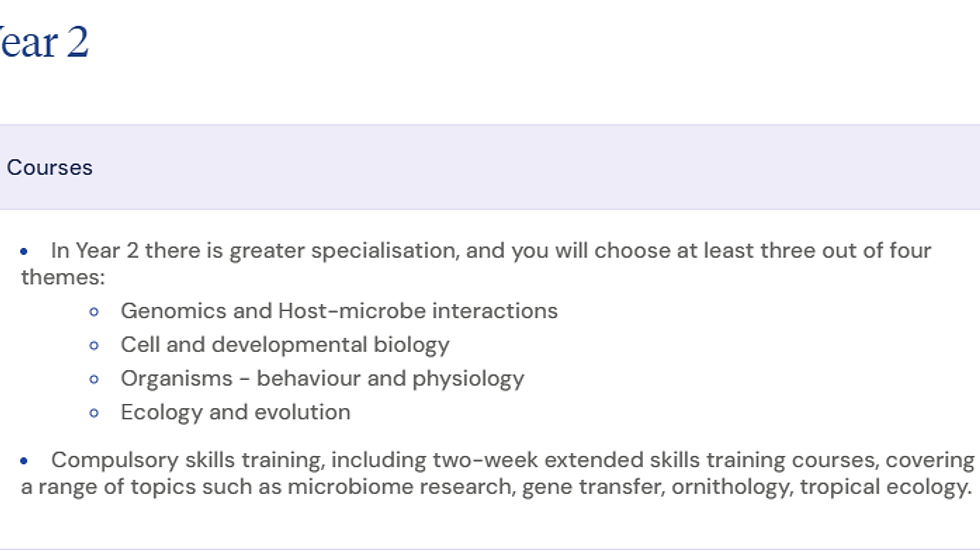
Biochemistry: A biochemist's lecture series looks quite different. While core aspects of cellular and molecular biochemistry involve shared lectures with biologists, the focus on mechanistic, physical, and quantitative biochemistry indicates a stronger emphasis on physical sciences. Notice how 'molecular' appears multiple times in biochemistry but not in biology.


Chemistry: The lecture content here is entirely focused on Chemistry. While Biochemists study physical and organic chemistry topics, chemists delve deeper into these subjects in Years 2 and beyond. There is also a larger emphasis on Maths, including topics like quantum and statistical mechanics.


What about the entry requirements?
Course | Grades (A-Level/IB) | Science Subjects Required | Admissions Test |
Biology (MBiol or BA) | A* AA / 39 | Biology + 1 other science (inc. Maths) | NONE |
Biochemistry (MBiochem) | A* AA / 39 | Chemistry + 1 other science (Maths recommended) | NONE |
Chemistry (MChem) | A* A* A / 40 | Chemistry and Maths (additional science strongly recommended) | NONE |
Chemistry is the most demanding of the three subjects academically, requiring both Chemistry and Maths as obligatory A-Level / IB HL subjects. However, the obligation has been relaxed with the removal of the TSA test from the admissions process. If you're appliyng to Natural Sciences at Cambridge, that will require an admissions test, however - read more about Oxford vs Cambridge here.
Biochemistry and Biology have similar requirements, but with some differences. Biochemistry requires Chemistry, while Biology requires Biology. Biochemistry also places greater importance on Maths as your other science subject. Another key consideration is that Biology can be pursued as a 3-year BA or a 4-year integrated master's. This flexibility allows you to enter a more specialized master's subject or end your studies after three years without an extended research project if you realize being a scientist isn't for you.
In summary, selecting A-Level subjects of Biology, Chemistry, and Maths makes all three subjects possible. However, a competitive Chemistry applicant will usually have 3 or 4 of the following: Maths, Further Maths, Physics, and Chemistry.
All subjects at Oxford require an interview. More on interview preparation can be found here.
What (likely) career paths can I take with these subjects?
With all these subjects, you can become a researcher in academia or industry, but your area of specialty will vary. Generally, remember that a Chemist can become a Biologist, but less so the other way around. Biochemistry and Chemistry are more suited for start-up environments, especially for those with an entrepreneurial mindset.
Patent law, which deals with trademarking and copyrighting scientific inventions, requires deep scientific knowledge and a Master's degree at a minimum. This makes Biochemistry and Chemistry stronger options for this route. Biology has an edge in ecology and environment-related careers, although Chemists are well-positioned in this field due to their knowledge of chemical and material synthesis.
For general career paths like consulting and finance, students from Biochemistry and Chemistry are more likely to be successful candidates due to the increased quantitative elements in these courses.
Where can I get extra support to decide between Biology, Biochemistry, or Chemistry at Oxford?
Hopefully, this guide serves as a useful starting point and provides insights into the differences between these subjects at Oxford. If you need further personalized support, whether it's a deeper exploration of topics and career paths or a strategic review of your current extracurriculars and personal statement, we're here to help.
From strategic consultation about subject choice to EPQ development, personal statement, and interview preparation, we're here to assist you every step of the way.
Book a consultation for a free consultation below.


Comments